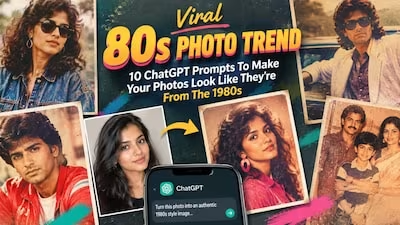
A viral artificial intelligence photo trend is transforming modern selfies into 1980s-style portraits across social media platforms. Users are uploading current photographs to AI image generators like ChatGPT and Google Gemini, prompting the tools to recreate their appearance as if photographed in the 1980s while retaining recognizable facial features.
The trend, often called the ChatGPT 80s photo trend, has moved beyond influencers and celebrities to include politicians, athletes, and everyday users. It works by instructing AI to alter clothing, hairstyles, accessories, backgrounds, and lighting to match the decade’s aesthetic, complete with film grain, faded colors, and warm studio tones.
Union Commerce and Industry Minister Piyush Goyal was among the first political figures to participate, sharing an AI-generated image on social media. In the picture, Goyal wears a grey suit, white shirt, and aviator sunglasses, with sepia tones and film grain giving it the look of an old studio photograph. He captioned the post, ‘Vibing to the 80s trend.’
Union Parliamentary Affairs Minister Kiren Rijiju also joined in, posting his retro image on X. His AI-generated picture shows him wearing sunglasses, a blazer, and an open shirt while posing beside a car. Rijiju wrote, ‘Why is everyone going back to the 80s vibes? I’m also forced to 80s nostalgia!’ He later shared an actual photograph of himself from the decade.
Assam Chief Minister Himanta Biswa Sarma shared his own retro AI image with the caption, ‘Getting to any trend which has nostalgia attached to it. Back to the 80s eh!’ Union Agriculture Minister Shivraj Singh Chouhan posted an AI-generated throwback wearing a sweater, writing, ’80s called, I answered.’ BJP MP Anurag Thakur also joined, sharing a retro-style image on Instagram with the caption, ‘joining the 80s trend.’
Congress MP Shashi Tharoor took a different approach to the trend. He wrote on X, ‘The ’80s seem to be back, courtesy of AI. I thought I’d join the trend the old-fashioned way.’ He then shared actual photographs from the 1980s featuring himself and his sons, Ishaan and Kanishk. Congress Sevadal also shared AI-generated retro images of Lok Sabha Opposition leader Rahul Gandhi.
Bollywood and Sports Stars Embrace Retro Look
Bollywood celebrities have also embraced the trend. Kiara Advani shared an AI-generated picture on Instagram Stories featuring her with husband Sidharth Malhotra. The couple appeared in retro avatars, with Sidharth in a classic double-denim look paired with dark aviator sunglasses, while Kiara wore a vibrant pink outfit with puff sleeves. She added Sidharth’s romantic track Samjho Na from his upcoming film The Vvaan to the post.
Parineeti Chopra joined with playful retro pictures featuring her husband, politician Raghav Chadha. In one image, the couple appeared to be posing at a colorful carnival while enjoying oversized pink candyfloss. Actress Ameesha Patel was seen in retro neon pink attire featuring a one-shouldered top and denim shorts, paired with leg warmers and white-and-pink trainers, sitting atop a large boombox.
Tahira Kashyap, wife of Ayushmann Khurrana, and Saba Ali Khan, sister of Saif Ali Khan, also shared their own retro-inspired versions. Shruti Haasan went a few decades further back to the 1960s, sharing a picture in a hippie-inspired look with a printed top, matching headscarf, and blue jeans.
Former cricketer Irfan Pathan shared a series of AI-generated retro photos on Instagram, writing, ‘Trend rukni Nahi chahiye. Let’s go back to 80s.’ Chess Grandmaster Praggnanandhaa also shared his AI-generated retro photo featuring him playing chess while wearing a denim jacket, with the caption, ‘Hoping onto the trend..’
How the Trend Works
The trend involves uploading a current photograph to an AI image generator and asking it to recreate the person as they might have looked in the 1980s. Prompts can instruct the AI to retain the person’s facial features while changing clothes, hairstyle, accessories, pose, background, and lighting.
For an Indian 1980s aesthetic, users often request colorful sarees, statement jewelry, voluminous hairstyles, moustaches, wide-collared shirts, high-waisted trousers, and retro sunglasses. Vintage studio backdrops, warm lighting, soft focus, faded colors, and analogue-style film grain are commonly used to make the images appear authentic.
Many photographs draw inspiration from 1980s Bollywood, when dramatic poses, elaborate costumes, bold hairstyles, and studio photography were a major part of popular visual culture. Users can customize the makeover by adding oversized sunglasses, switching to dramatic hairstyles, trying vintage outfits, or requesting portraits that could have appeared in old magazines.
The trend has spread across Instagram, X, Facebook, and TikTok, with users sharing their AI transformations through Reels, tweets, and the platform’s ‘Add Yours’ feature. The format has also expanded beyond simple portraits to include 1980s Bollywood stars, old family photographs, Doordarshan-era studio portraits, retro street scenes, discos, and arcade settings.
Psychological Appeal
Psychologists and sociologists have identified the trend as ‘digital nostalgia travel,’ tapping into a deeper psychological void. Research published in psychology journals suggests three key factors explain why the brain gravitates toward the 1980s over other eras.
The 1980s marked a golden era for pop music, retro fashion, neon lights, and Hollywood worldwide. The decade’s clothing styles, including denim jackets and oversized blazers, alongside voluminous hair, now read as an aesthetic peak to today’s Gen Z and millennial audiences. The brain’s reward center naturally releases dopamine when exposed to these colorful, classic visuals.
Research published in the journal Computers in Human Behavior found that people today live under constant psychological pressure from artificial intelligence, notification alerts, and endless doom-scrolling. The 1980s represented an early stage of technology when people were not yet trapped in the internet’s web, offering a kind of peace. When people view AI-generated images of themselves from that era, the brain registers a sense of safety and calm.
A study by sociologists published in Public Opinion Quarterly found that presenting a nostalgic version of oneself on social media creates a deep sense of individuality. When friends comment beneath those retro photos and share their own versions, a ‘co-regulation’ process occurs.
Psychologist Clay Routledge has studied why younger people feel drawn to eras they never experienced. In a recent Big Think article, he described this as historical nostalgia and pointed to research suggesting that nostalgia can support meaning, social connection, creativity, and optimism. Routledge said surveys conducted by his team found that around two-thirds of Gen Z adults felt nostalgic for a time before they were alive, often due to desires for control and community.
Evolution from Previous AI Trends
The 1980s trend follows a line of AI-powered social media crazes. In 2025, the Ghibli Studio trend transformed photos into Japanese anime style with soft watercolor looks and dreamy backgrounds. The Nano Banana trend featured a glossy, cinematic, and vibrant 1990s look with high contrast and Pinterest-style images.
The 80s trend differs from these earlier trends because it aims for photorealism rather than artistic or stylized transformation. The AI yearbook trend first took off in late September 2023 when South Korea’s Snow Corporation launched a vintage filter on its EPIK app. Top K-pop stars including BTS member V, (G)I-DLE singer Miyeon, and K-pop star Somi used the filter on their official Instagram accounts, sending the app viral worldwide.
The current wave has arrived as generative AI image tools like ChatGPT and Google Gemini have become free and accessible to users. Breaking free from expensive subscription apps, young people, particularly university students and corporate professionals, began transforming their own photos into retro looks using simple prompts.
The trend has also made its way into political circles across party lines. The BJP’s official Instagram account posted vintage-style images with the caption ‘PM Modi ft. 1980s era!’ though the photo appears to be a real image rather than AI-generated. Congress Sevadal shared AI-generated retro images of Rahul Gandhi, showing him in a brown jacket, white shirt, and beige trousers.
Renuka Chowdhury shared a real 1980s magazine cover of herself instead of an AI-generated image. The trend has spread globally, with users in Bangladesh participating through two distinct phases. In late 2023, following the international trend, top models, entertainment figures, and content creators used apps like EPIK or Lensa AI to share vintage-style photos. The second and larger wave has arrived now as generative AI tools have become completely free and accessible.
Cricketer Mushfiqur Rahim posted a retro-style photo on Facebook with the caption, ‘Going with the trend.’ Ramp model and choreographer Azra Mahmood, actress Toya, and several popular lifestyle influencers also participated, swapping their usual modern look for 80s catalogue-style portraits.
As AI-generated nostalgia continues to dominate social media, the 80s trend offers users a simple way to imagine themselves in another era without needing an old photograph or complicated editing software. The trend combines nostalgia and transformation, allowing people to decide what their 1980s self would have looked like.